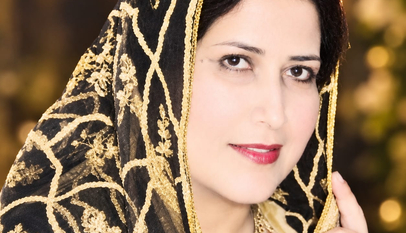


Dr. Samina Gul hails from Sargodha. She is a fresh and blossoming branch of the tree of poetry whose fragrance has attracted countless lovers of literature and poetry. She is a well-known poetess and literary critic. A few years ago, her Urdu poetry collection “Didam” was published. She had sought my opinion on the book, and the column I wrote on it was later included in my Urdu collection of essays, “Adabi Tabsaray” (Literary Reviews). The book contains prefaces, forewords, and reviews of works by contemporary writers and poets who had requested my views on their publications. It has recently been published by the National Book Foundation, Islamabad, under the Ministry of Federal Education, Government of Pakistan.
Dr. Samina Gul’s recently published book, “The Religion of the Earth,” is a collection of free verse, prose poems, and blank verse. She has requested my opinion on the book in English, presumably with the intention of introducing it to English-speaking readers as well.
I have read this book with great attention and interest. It is a beautiful blend of the emotional, reformative, and intellectual expression of an extremely sensitive soul. “The Religion of the Earth” is a strange, resonant, and passionate voice that surprises the reader and compels them to think. For the poetess, the true religion of the earth and its inhabitants is love, freedom, compassion, justice, and brotherhood. It is indeed a deeply thought-provoking title.
The word “religion” may refer to belief, creed, faith, or a system of worship. However, through the title of this book, the poetess essentially conveys that the earth is the true place where human beings should live and love. The earth is like a sacred sanctuary, a home of peace, purity, happiness, and prosperity for all humanity. The earth is sacred and nurturing, like a compassionate mother. The concept of the motherland teaches us to love and respect the entire earth and all its inhabitants without discrimination.
The renowned American poet Robert Frost also attached extraordinary importance to the earth, describing it as the best place to live and love.
In this collection, Dr. Samina Gul emerges as a herald of love, life, justice, harmony, humanity, brotherhood, universality, equality, and prosperity. She advocates positive and progressive ways of living and offers constructive visions for human life.
The language of these poems is remarkably simple, graceful, and captivating. Some poems are written in blank verse, others in free verse, while some take the form of prose poetry. Yet, in all of them, poetic musicality and rhythmic flow have been maintained with great skill. These are brief yet comprehensive poems that capture the reader through their beautiful imagery and emotional impact. The similes and metaphors are natural, beautiful, and appealing.
The central theme of all the poems in the book is the search for happiness, peace, and harmony among different sections of society. All human beings are like members of one community and one family. The protection and security of the inhabitants of the earth constitute the true religion that should be embraced, adopted, and translated into practice.
Some poems in the book are also devoted to prominent literary personalities, including Faiz Ahmed Faiz, Nasir Kazmi, and N. M. Rashid, whom the poetess pays tribute to for their valuable literary contributions. Each poem carries its own meaning and message; however, a few deserve particular mention because of their universal appeal and humanitarian purpose.
In particular, “The Religion of the Earth” and “Stories of the Earth” are representative poems that powerfully reflect the fundamental message of the book. On the one hand, these poems portray the enchanting beauty of the earth—its lush green fields, plateaus, springs, waterfalls, mountains, and breathtaking natural landscapes. On the other hand, they depict the helplessness, anxiety, despair, suffering, pain, and hardships of deprived and oppressed people who are suffocating in the dark and terrifying deserts and underground chambers of life.
The poem “The Withered Chinars” is particularly significant in its revolutionary context. In another poem, the poetess describes the suffering and anguish of Kashmiris who migrated from Kashmir to Pakistan at the time of the Partition of the Indian subcontinent. The chinar leaf is a symbol of Kashmiri culture and represents the flames emerging from the heart of the earth.
Dr. Allama Iqbal said:
“The soil whose essence contains the fire of the chinar
Can never grow cold—that noble soil.”
In other words, the flames of a sacred and precious land whose very essence contains the fire of the chinar can never be extinguished.
Withered chinar leaves symbolize autumn on the earth and, metaphorically, represent the melancholy autumn of life. The poetess longs for a fresh and life-giving season that can breathe new life into lifeless particles. She yearns for a spring that will fill the earth with mercy, happiness, joy, love, life, compassion, comfort, justice, peace, brotherhood, humanity, and prosperity.
The book also contains a comprehensive poem on Kashmir, which is deeply moving and poignant. In this poem, the poetess portrays the continuing suffering and hardships of unarmed Kashmiris under the occupation of Indian forces in occupied Kashmir. Her love for her motherland appears profound and deeply rooted in her heart.
At the same time, she rejects the negative values that have distorted the beauty and sanctity of human life. She denounces hatred, anger, conflict, sinister ambitions, and social injustice.
Her poetry is a double-edged sword: on one side, it carries romanticism, while on the other, it resounds with a call for revolution.
In her poem “Selfhood,” the poetess conveys a clear message of self-respect and self-awareness at both individual and collective levels. The poem is a powerful call for oppressed and marginalized communities to raise their voices against tyranny and injustice. It inspires the human spirit to live with determination, perseverance, and unwavering resolve.
Dr. Allama Iqbal is renowned throughout the world for his philosophy of Khudi (selfhood). He infused the spirit of self-awareness into declining humanity and acquainted people with the secrets of dignity and self-respect. His two great Persian works, “Asrar-e-Khudi” (The Secrets of the Self) and “Rumuz-e-Bekhudi” (The Mysteries of Selflessness), are invaluable contributions to the understanding of selfhood and consciousness.
Dr. Samina Gul also appears to be inspired by the philosophical and revolutionary mission of the great Eastern poet, Dr. Allama Iqbal.
Among modern existentialist thinkers, Jean-Paul Sartre is a prominent name. He contributed significantly to the development of existentialist philosophy, which emphasizes individuality, humanity, and freedom.
Every thinker and philosopher longs for a messiah who can heal the wounds of humanity. The poetess’s poem “The Messiah” is particularly powerful in its message. In literature, a messiah is understood as a person who delivers humanity from suffering and affliction.
Dr. Samina Gul, too, searches for such a messiah who can cleanse the earth of all its social and spiritual ailments. Like all conscientious and enlightened people, she dreams of establishing a paradise on earth—and this, indeed, is “The Religion of the Earth.”
The book contains two poems entitled “The Leader.” In them, the poetess pays a glowing tribute to the founder of Pakistan, Quaid-e-Azam Muhammad Ali Jinnah, whom she portrays as a selfless and great leader. She considers the golden principles given by Quaid-e-Azam to the nation an effective remedy for freeing society from its evils.
Another poem, “Crime,” focuses on the misery and helplessness of a young child who sometimes washes dishes in a restaurant, sometimes cleans cars, and at other times collects scraps of paper from garbage heaps and rubble. He complains about the injustice prevailing in a capitalist society and mourns his misfortune. His greatest desire is to become a student like other children and attain dignity and respect in life.
The poem is a powerful indictment of the injustices prevalent in a capitalist social order. Through it, the poetess highlights the need and desire for social justice.
The book also contains several other poems, including “Thirst,” “Love,” “Tears,” “Moonlight,” and “Life,” which shed light on various dimensions of human existence.
In short, this collection of poetry is a beautiful addition to Urdu literature. It is not only a strong and powerful voice against injustice but also a blessing for those who believe in human values, love, peace, justice, and brotherhood.
I congratulate Dr. Samina Gul on writing these poems not merely with ink, but, metaphorically, with the blood of her heart.
Faiz Ahmed Faiz beautifully expressed this spirit:
“What if the treasures of pen and tablet have been taken away?
I have dipped my fingers in the blood of my heart.
If a seal has been placed upon my tongue, so be it;
I have placed a tongue upon every link of the chain.”
Let us break these chains and shackles and transform the earth into a paradise where human beings can live with happiness, peace, and contentment, free from all forms of racial prejudice, discrimination based on colour and race, and religious extremism.