
By Dr. Shahid Zia
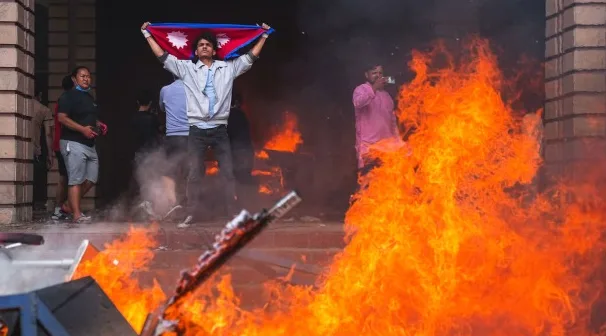
Nepal has offered South Asia a stark warning about the fragility of political stability in the digital age. What began as a government order requiring social media companies to register locally, or face a ban, quickly spiralled into one of the largest political crises the Himalayan republic has seen in years. Within days of the announcement, thousands of young Nepalis poured into the streets of Kathmandu and other major cities, demanding not only digital freedom but also accountability, fairness and an end to elite privilege.
The movement, led overwhelmingly by Generation Z, transformed into a confrontation that left dozens dead, hundreds injured and the capital paralysed. Protesters stormed parliament, defying curfews and security blockades, as the government resorted to tear gas and live fire. The backlash proved too strong. Prime Minister K.P. Sharma Oli resigned, the ban was rescinded, and elections were announced. Yet the political cost went far beyond a single resignation. Nepal’s ruling elite had badly misread its citizens.
Although social media regulation triggered the protests, the underlying anger ran deeper. Young Nepalis are weary of corruption and nepotism, tired of being shut out of opportunity, and frustrated by a political system that seems to reward connections over merit. With limited jobs at home and an economy that forces thousands to migrate abroad every year, disillusionment with politics had already been building. The attempted curtailment of online space — where many youths find expression, income and solidarity — became the breaking point.
For Pakistan, the lessons are sobering. Our own political history is punctuated by moments when public anger overwhelmed established authority. In 1968–69, student and worker protests eroded Ayub Khan’s regime. In 1977, allegations of electoral fraud brought opposition parties to the streets, paving the way for military intervention. In 2007, the lawyers’ movement against General Musharraf reshaped the country’s political order. More recently, sit-ins in 2014 and the post-2022 mobilisation after Imran Khan’s ouster showed how street politics can dominate the national conversation when institutional credibility is weak. In each case, as in Nepal, a spark ignited long-simmering frustrations with governance, corruption and legitimacy.
A lesson that South Asia needs to learn from Nepal situation is that digital repression is a political dynamite. Attempts to restrict Twitter, YouTube or TikTok in South Asian countries have already sparked outcry. For the countries where youth is more than 60 per cent of the population, internet is not a luxury but a necessity: a marketplace, a classroom, a community and a political forum. Efforts to curb this space without transparency and consent are likely to be perceived as authoritarian overreach, and could provoke similar mobilisation that overwhelmed Nepal’s government.
The Nepali protests also echo another recent upheaval in the region. In Bangladesh, student-led demonstrations against the quota system in government jobs expanded into a nationwide movement against corruption and authoritarianism, forcing dramatic concessions from the ruling Awami League earlier this year. The parallels are striking: a youthful population, a narrow political elite, and institutions that failed to channel grievances before they erupted onto the streets.
From the recent movements in South Asia it also got obvious that young people are no longer passive in South Asia’s political landscape. Nepal’s Gen Z has shown the power of organisation through both online networks and physical protest. In Pakistan, where unemployment, inflation and frustration are rising, a similar mobilisation is not unthinkable. To ignore or patronise this demographic is to risk destabilisation.
The movements of Nepal and Bangladesh also show that policy makers failed to learn that violence often backfires. Governments across the region have often believed that tear gas, batons or live fire can restore order. Yet history shows that excessive force only deepens resentment and accelerates collapse. The death toll in Kathmandu transformed a policy dispute into a moral crisis, creating martyrs and fuelling demands for systemic change. Pakistan’s own history, from the protests of 1968 to the lawyers’ movement, bears witness to this pattern.
Finally, there is the reality of cumulative grievances. States often see protests as reactions to immediate triggers, but in truth they reflect years of unaddressed frustrations. In Nepal, the social media ban was simply the last straw. In Pakistan, decades of politics of power, contested institutions, and widening inequality mean that anger is already simmering. Continuous attempts at repression, especially digital repression, could provide the spark.
The upheavals in Nepal and Bangladesh are not isolated stories but regional warnings. South Asia’s youthful societies are no longer willing to accept corruption, exclusion and censorship without protest. When institutions lose credibility and ballots no longer seem to matter, people inevitably take to the streets. For Pakistan, the choice is clear: confront corruption honestly, create economic opportunity, and protect freedom of expression, or face the risk of being overtaken by a deep crisis that resignations or cosmetic reforms may fail to contain.
Nepal is burning, and its flames cast a long shadow across the subcontinent. The lesson for Pakistan is not whether unrest can happen here — history shows it already has, and will again. The question is whether the country’s leaders are willing to act before the fire reaches their own doorstep.