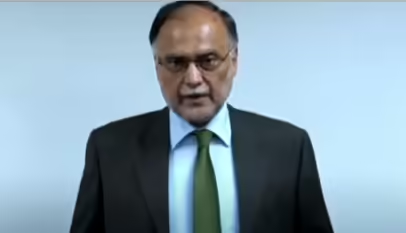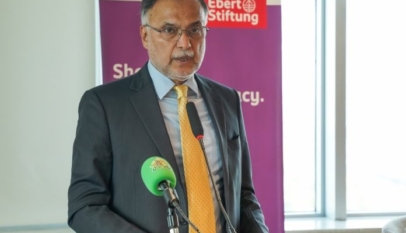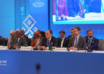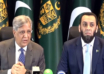

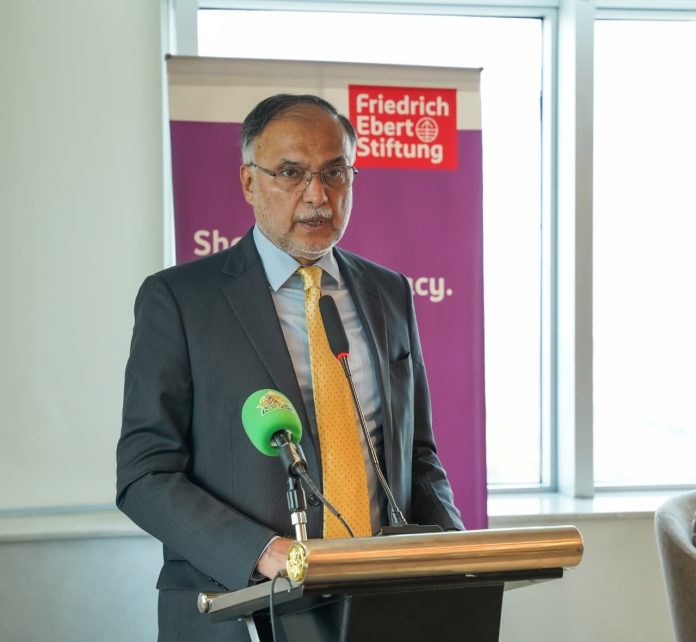
Federal Minister for Planning, Development, and Special Initiatives Professor Ahsan Iqbal on Tuesday stressed the need to reinvent democracy in line with the technological, informational, and demographic revolutions shaping the 21st century.
Addressing a seminar titled “Shaping Social Democracy – Since 1925,” held to mark the centenary celebrations of Friedrich Ebert Stiftung (FES) and 35 years of its partnership with Pakistan, the minister congratulated FES for its global service in promoting social justice, democracy, and solidarity.
He said the foundation had long stood at the heart of social democracy, advancing dignity, fairness, opportunity and representation.
Ahsan Iqbal said Pakistan valued its friendship with Germany, rooted in mutual respect and cooperation, adding that the partnership was expanding in areas such as climate resilience, digital governance and vocational training.
He proposed launching an “ideas lab” to study the ongoing crisis of democracy and adapt its model to meet the realities of the digital era.
Highlighting Uraan Pakistan vision, he said it revolved around five pillars – exports, e-Pakistan, energy and infrastructure, environment and climate change, and equity and empowerment – to ensure democracy delivers tangible outcomes. “Democracy does not survive on slogans but on real representation, visible accountability, and services that citizens can feel,” he remarked.
He outlined three priorities for democratic renewal, including revitalising local governments with predictable financing, digitizing procurement and accountability systems, and publishing service charters with grievance redressal timelines.
Under Uraan Pakistan, he noted that several reforms had already taken shape, including the first-ever digital census, revival of parliamentary SDG oversight, youth civic engagement programmes, and real-time monitoring of development projects.
Calling for regional cooperation, Ahsan Iqbal urged South Asian countries to transform from “a battleground of rivalries into a platform of collaboration” through trade facilitation, power exchange, climate data sharing and skill recognition.
He said Pakistan’s new economic vision – Connect, Lead, and Grow – aimed to align green industrial growth with resilient value chains in partnership with Germany and the EU.
He also stressed the importance of preparing for the “future of work” through education reforms, promoting women’s participation in STEM (Science, Technology, Engineering, and Mathematics), and providing social protection for informal and platform workers. “This is the justice dividend of social democracy — growth that is equitable, inclusive, and humane,” he said.
The minister said democracy must evolve to become more inclusive, participatory, and responsive to the digital age. “Only then can we counter the populist politics of hate and prejudice and make democracy credible again,” he added.