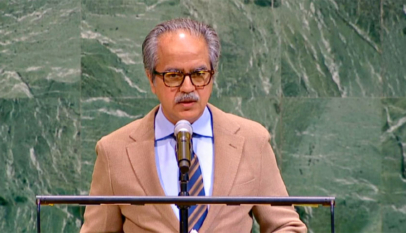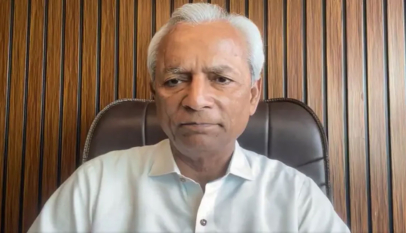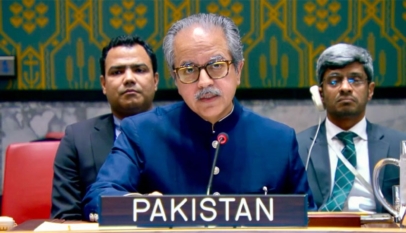

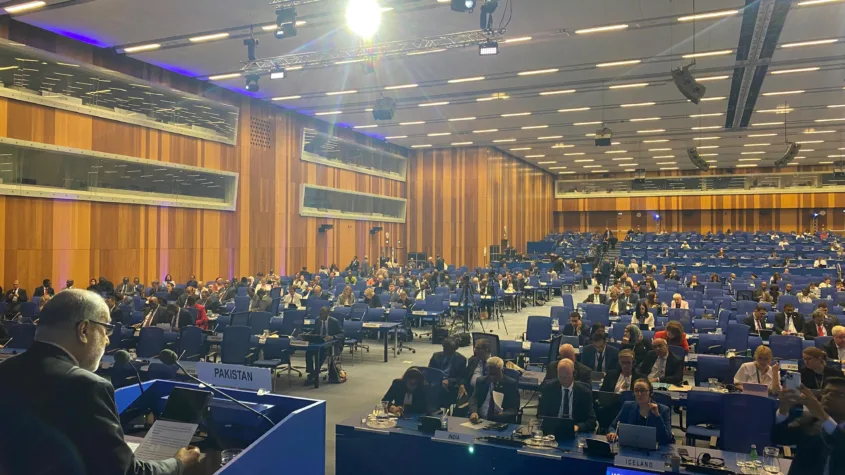
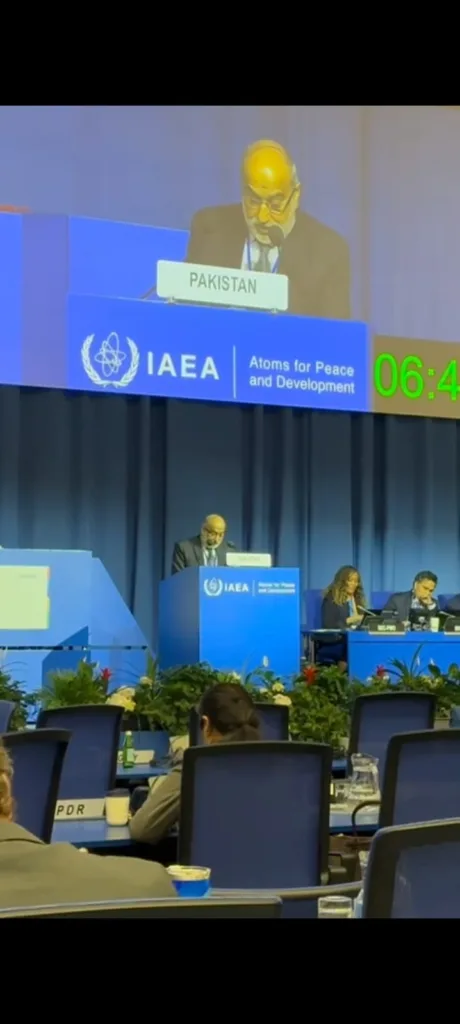
Chairman Pakistan Atomic Energy Commission (PAEC), Dr. Raja Ali Raza Anwar, delivered Pakistan’s National Statement at the Plenary Session of the 69th General Conference of the International Atomic Energy Agency (IAEA) in Vienna.
At the outset, Dr. Anwar congratulated the newly elected officers of the General Conference and welcomed the Republic of Maldives on joining the Agency.
Referring to the global climate challenge, he underlined that Pakistan, despite being among the lowest carbon emitters, is highly vulnerable to the adverse effects of climate change. He stressed that Pakistan remains committed to international efforts for reducing climate-related risks and is making significant contributions through the peaceful uses of nuclear technology.
The Chairman informed the Conference that Pakistan has six nuclear power plants in operation with a total capacity of 3,530 MW. In the past year, nuclear power accounted for 18.3% of the country’s electricity mix and represented 34% of low-carbon energy production, helping avoid nearly 15 million tonnes of CO₂ emissions annually. He added that a new 1200 MW nuclear power plant (C-5) is under construction and expected to be operational by 2030.
Highlighting Pakistan’s 108 reactor-years of safe, secure, and fully safeguarded nuclear power operations, Dr. Anwar emphasized the importance of unrestricted collaboration and fair access to civil nuclear technologies, particularly for nations most vulnerable to climate change.
He reaffirmed Pakistan’s strong support for the IAEA’s initiatives, including Atom for Net Zero, Rays of Hope, Atoms for Food, ZODIAC, and NUTEC Plastics, acknowledging their impact on sustainable development.
He further elaborated on Pakistan’s achievements in the peaceful uses of nuclear technology. In the health sector, PAEC operates a network of 20 cancer hospitals which together perform over one million diagnostic and therapeutic procedures every year, serving more than 80% of the country’s cancer patients. NORI, as an IAEA Anchor Center, has also trained a batch of international fellows under the Rays of Hope initiative. In agriculture, PAEC’s four research institutes have developed over 150 high-yield and disease-resistant crop varieties through nuclear techniques. The Nuclear Institute for Agriculture and Biology (NIAB), an IAEA Collaborating Center, has made notable progress in cotton, wheat, rice, and chickpea research. Pakistan has also been selected among the first countries to benefit from the joint IAEA–FAO Atoms for Food initiative.
Turning to water security, Dr. Anwar noted that Pakistan has applied isotope hydrology to improve groundwater mapping and ensure sustainable resource management. PINSTECH, which has been designated as an IAEA Collaborating Center, contributes actively to the Agency’s GloWAL network in this field. In education and training, he highlighted the role of PIEAS, another IAEA Collaborating Center, which continues to strengthen nuclear education by offering 20 fully funded international scholarships in nuclear science and technology, in addition to five more scholarships under the IAEA’s Marie Curie Fellowship Programme for 2025–26.
On nuclear safety and security, Dr. Anwar reaffirmed that Pakistan adheres strictly to the highest standards consistent with IAEA guidelines. The Pakistan Nuclear Regulatory Authority (PNRA) functions as an independent national regulator and has recently granted the construction license for C-5.
He further informed that Pakistan conducted its first National Radiation Emergency Exercise in 2024, hosted the IAEA’s ConvEx-2c, and actively participated in ConvEx-3 in 2025. The Pakistan Centre of Excellence in Nuclear Security (PCENS), under a Practical Arrangement with the IAEA, continues to play a vital role in national and international capacity building. He added that Pakistan will host the IAEA International Physical Protection Advisory Services (IPPAS) Mission and the IAEA Nuclear Security Support Centre (NSSC) meeting in 2026.
Concluding his statement, Dr. Anwar reaffirmed that Pakistan stands ready to further strengthen its partnership with the IAEA and Member States in advancing the peaceful uses of nuclear technology to promote sustainable development and address the challenges of climate change.