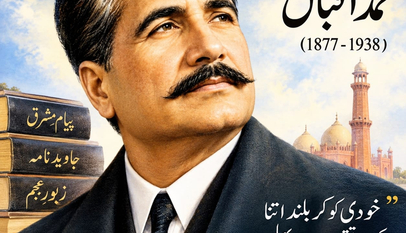

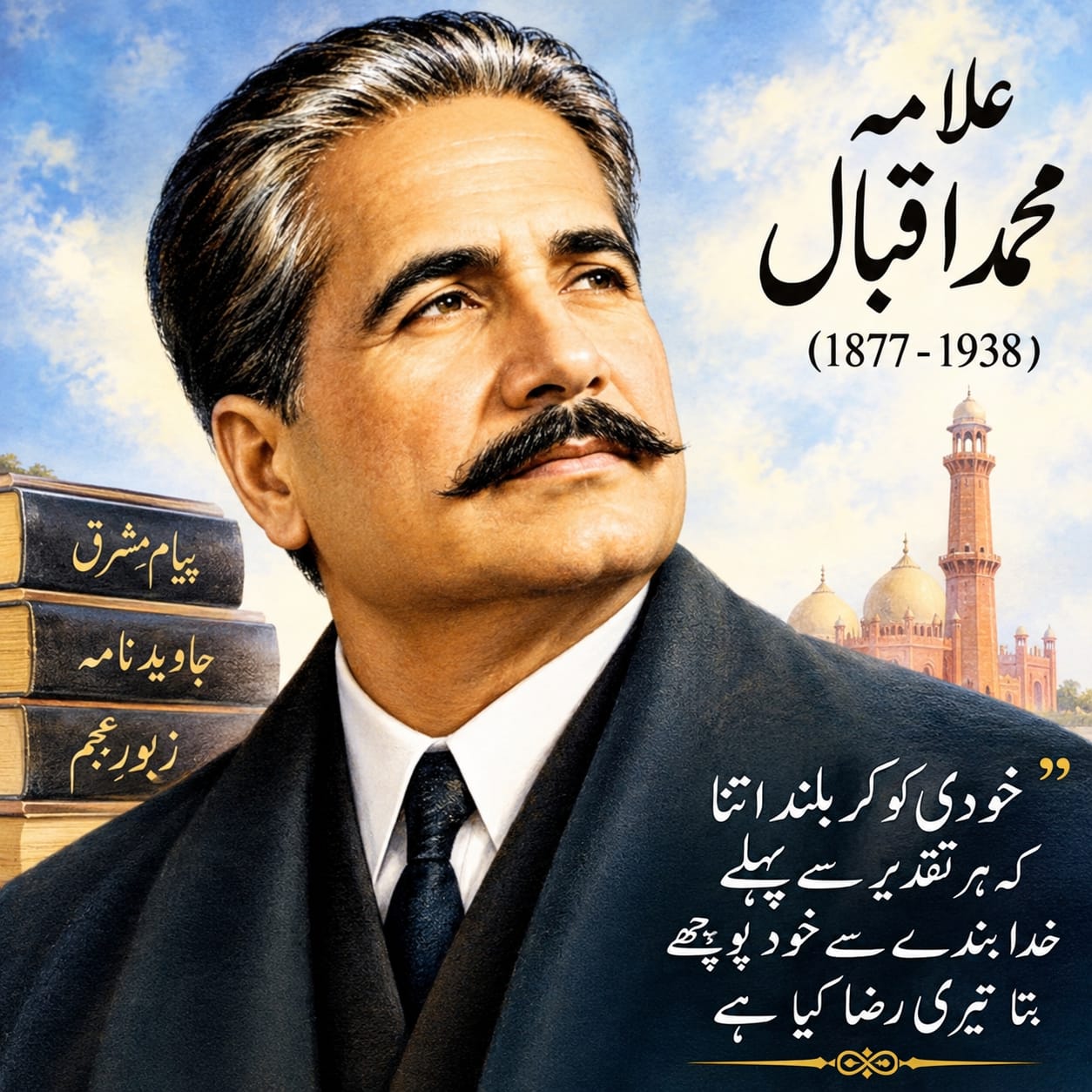
Allama Muhammad Iqbal was one of the brightest stars in the history of the subcontinent. His intellectual insight, literary excellence, philosophical depth and spiritual wisdom inspired not only the Muslims of the subcontinent but also scholars and intellectuals across the world. He was much more than a poet, philosopher or thinker. He was an eminent visionary, a champion of Muslim awakening and a great guide who taught humanity the values of self-realisation, self-confidence and noble character. His philosophy beautifully combines the light of knowledge, the elegance of literature, the passion of love and the depth of spirituality.
One of the most prominent aspects of Allama Iqbal’s personality was his outstanding intellectual stature and broad vision. He studied Eastern knowledge and philosophy alongside Western philosophical thought and modern intellectual trends. He possessed profound insight into subjects such as philosophy, history, religion, politics, society and human psychology. He did not use his intellectual abilities merely for personal fame or academic distinction. Rather, his fundamental objective was to liberate Muslims from intellectual subjugation, despair and stagnation and transform them into a vibrant, progressive and dignified nation. In his view, knowledge is a powerful force that enables human beings to recognise their true identity, understand the mysteries of the universe and determine the purpose of their existence.
Allama Iqbal’s literary stature was equally remarkable. Through his Urdu and Persian poetry, he introduced a distinctive style in which philosophy, wisdom, love, selfhood, Muslim unity and human dignity are expressed with exceptional brilliance. His poetry is not merely an expression of emotions; rather, it represents a comprehensive intellectual movement. He transformed poetry into a powerful instrument for social reform, character building and awakening of the human conscience. His verses offer hope to young people, guidance to the Muslim nation and inspiration to humanity as a whole.
Iqbal’s philosophy of Khudi (selfhood) is the fundamental pillar of his thought. Khudi does not mean arrogance, pride or self-conceit. Rather, it refers to self-awareness, recognition of one’s abilities, self-confidence, determination and commitment to the purpose of life. Iqbal wanted individuals to recognise their hidden potential, confront challenges with courage and dedicate their lives to achieving higher objectives. He often used the falcon as a symbol for young people because it represents lofty ambitions, self-respect, freedom and courage.
He beautifully expressed this philosophy in one of his immortal couplets:
Elevate your selfhood to such heights that before every decree of destiny,
God Himself may ask you: Tell Me, what is your desire?
These lines are not merely an example of poetic beauty; they present a comprehensive philosophy of human dignity, moral excellence and spiritual development.
Another remarkable aspect of Allama Iqbal’s personality was his spiritual vision. In his view, spirituality did not mean withdrawing from worldly affairs. Rather, it meant establishing a strong relationship with Almighty Allah while leading a purposeful, active and principled life in this world. He regarded divine love as the greatest source of strength in human life. According to his philosophy, love inspires faith, action, sacrifice and perseverance. Iqbal believed that reason guides human beings towards the right path, while love provides the courage and determination to follow it.
His concept of Sufism was also not confined to outward rituals and formal practices. Instead, it was founded upon the teachings of the Holy Quran and Sunnah, purification of the soul, service to humanity, purity of character and a genuine connection with Almighty Allah. He envisioned a spiritually enlightened individual who combines worship with action, love with sincerity and faith with a sense of responsibility.
Allama Iqbal gave special importance to the younger generation in his poetry. He considered young people the most valuable asset of a nation and the architects of its future. He believed that a nation whose youth possess strong character, firm faith, a passion for knowledge and a spirit of hard work cannot be prevented from achieving progress. He encouraged young people to overcome despair, inferiority complexes and intellectual subjugation and inspired them to struggle for higher goals.
He expressed this message in another famous couplet:
You are a falcon; soaring high is your destiny,
There are countless more skies beyond your reach.
These lines encourage young people to believe in their abilities, abandon limited thinking and move towards greater opportunities and higher ambitions.
Allama Iqbal’s contribution to national and collective consciousness is also an unforgettable chapter in history. He awakened Muslims to their cultural identity, religious heritage and collective responsibilities. In his historic Allahabad Address of 1930, he presented the vision of a separate political entity comprising the Muslim-majority areas of north-western India. This vision subsequently strengthened the intellectual foundations of the Pakistan Movement. It is for this reason that he is widely remembered as the Thinker of Pakistan.
Iqbal’s message is not restricted to a particular era, region or nation. It offers guidance to all humanity. He taught people to rise above the boundaries of colour, race, language and geography and embrace humanity, justice, equality, love and respect for human dignity. In his view, an ideal society can only be established on the foundations of knowledge, morality, justice, brotherhood and collective responsibility.
There is a pressing need to incorporate Iqbal’s thoughts and teachings into our individual and collective lives. Introducing the younger generation to his poetry, philosophy and intellectual contributions is an important requirement of the present era. This will enable young people to demonstrate their full potential in the fields of knowledge, action, character, expression and intellectual development.
The reality is that Allama Muhammad Iqbal is not merely the name of an individual; rather, he represents a complete intellectual and spiritual movement. His poetry ignites enthusiasm in hearts, his philosophy enlightens minds, his intellectual insight provides guidance, and his spiritual teachings create awareness of a meaningful relationship with the Creator.
The central message of Iqbal is that Muslims should recognise their selfhood, make knowledge their strength, place their love for the Holy Prophet Muhammad (PBUH) at the centre of their lives, make noble character their identity and achieve their goals through continuous struggle and dedicated action.
Undoubtedly, Allama Muhammad Iqbal’s philosophy is an everlasting beacon of light that will continue to guide generations to come. His intellectual, literary and spiritual legacy is a priceless asset of our national and collective identity. If we truly understand his teachings and incorporate them into our practical lives, there is no reason why we cannot succeed in building a dignified, self-respecting, knowledge-oriented and progressive society.
Allama Iqbal lives on — in his thoughts, his poetry, his philosophy and the dream whose fulfilment still awaits us in the form of a self-respecting, enlightened and action-oriented nation.