
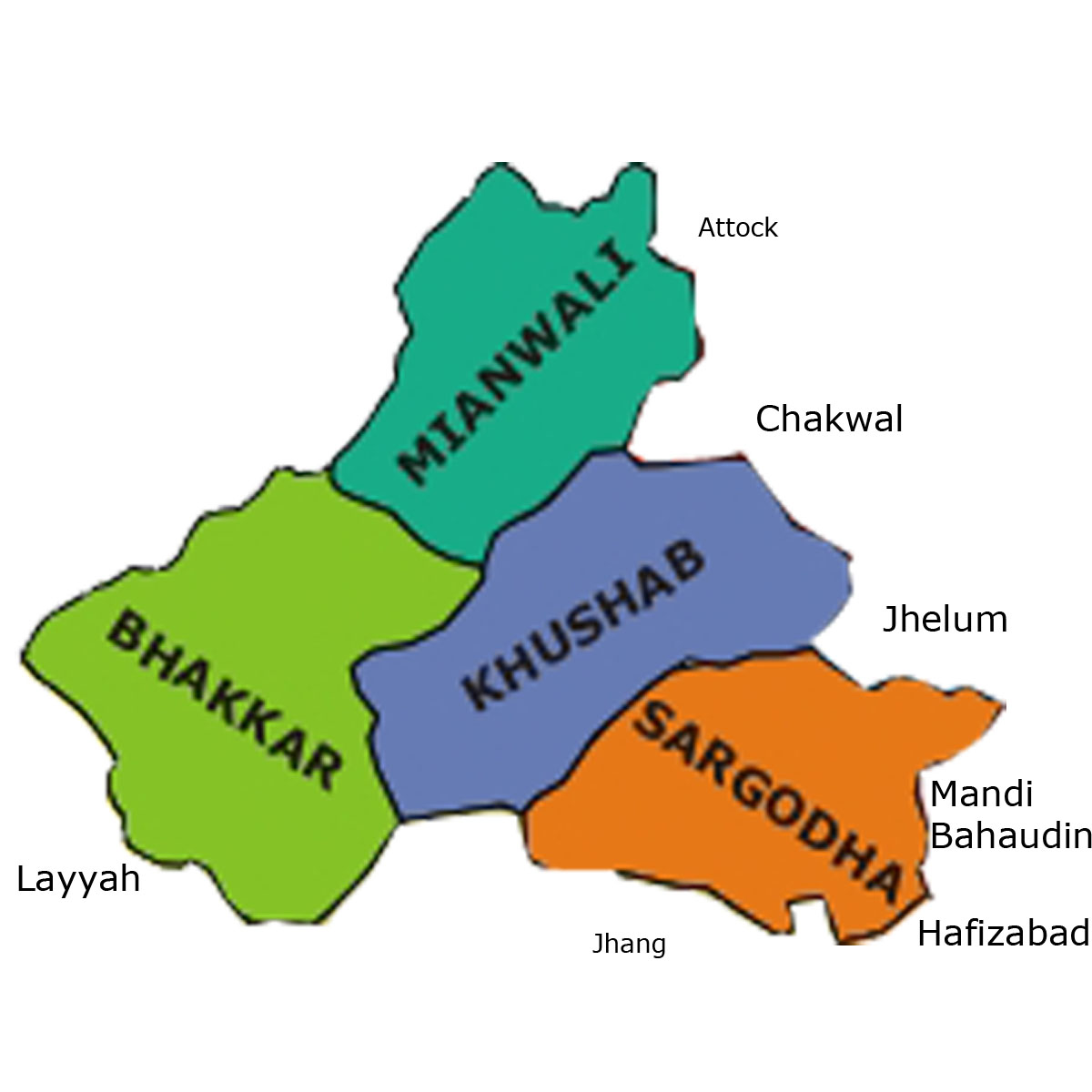
Sargodha Division is one of the remarkable regions of Punjab where history, geography, agriculture, culture and human civilization are so deeply interconnected that every city, town and ancient settlement has a unique story to tell. Comprising Sargodha, Khushab, Mianwali and Bhakkar districts, the division holds a significant position not only on the geographical map of Punjab but also in the history, economy, agriculture, literature and cultural heritage of Pakistan.
The geographical significance of Sargodha Division can be understood by looking at its strategic location. The region serves as an important link between the central and western parts of Punjab. Its proximity to the River Jhelum and the River Indus, along with its connection to the surrounding riverine plains, has profoundly influenced its geography, climate, agriculture and way of life. From fertile agricultural plains to the mountainous landscape of the Soon Valley, the Salt Range and the vast desert-like expanses of Thal, the division presents an extraordinary diversity of natural scenery.
Sargodha city may rightly be described as the administrative, economic, commercial and agricultural centre of the division. The city is particularly famous for its high-quality kinnow, which has earned recognition both nationally and internationally. The citrus orchards of Sargodha are not only an important pillar of the local economy but also play a significant role in Pakistan’s agricultural and export sectors. Kinnow has become a beautiful symbol of Sargodha’s agricultural identity. Wheat, sugarcane, rice and other crops also hold an important place in the agricultural economy of the region.
Khushab is another highly significant district of Sargodha Division because of its distinctive geographical and historical features. The Soon Valley, Katha, natural lakes, springs, historic sites and the Salt Range add greatly to the beauty and importance of the area. The Soon Valley, in particular, is exceptional for its natural beauty, historical remains and traces of ancient settlements. Its mountains, lakes, springs and old settlements testify to the fact that this region has been associated with human life and civilization for centuries.
When Mianwali is mentioned, the River Indus, Kalabagh, Chashma Barrage and its vast agricultural and semi-desert landscapes immediately come to mind. Geographically, Mianwali serves as an important junction connecting Punjab with Khyber Pakhtunkhwa and the Thal region. The River Indus has profoundly influenced the social life, agriculture and economy of the area. The simplicity, hard work, resilience and traditional values of the people of Mianwali are among the defining characteristics of the region.
Bhakkar, meanwhile, is an important centre of the vast Thal region. The sandy landscape, mud houses, wells, livestock, fields and hardworking communities have created a distinctive culture of their own. Thal is not merely a sea of sand; it represents a living culture that has taught generations the values of hard work, patience, resilience and self-reliance despite challenging geographical and climatic conditions. Its folk tales, traditional clothing, local cuisine, fairs and indigenous sports remain an integral part of Pakistan’s cultural heritage.
Punjabi language and folk literature occupy a central place in the cultural life of Sargodha Division. In rural areas, folk songs, dohre, maahiyas, tappay and Sufi poetry continue to be part of everyday life. The intellectual and spiritual traditions of great Punjabi Sufi poets have also influenced the spiritual and literary life of the region. At local fairs and urs celebrations, centuries-old traditions can still be seen flourishing.
Traditional sports are another beautiful aspect of the region’s cultural identity. Kabaddi, wrestling and other indigenous sports continue to be organised enthusiastically in rural areas. Particularly in Thal, kabaddi is not merely a sport; it is a symbol of collective joy, social interaction and cultural identity. Such sporting events also provide an effective means of connecting the younger generation with their soil, traditions and cultural heritage.
Sargodha Division has also produced notable personalities in the fields of literature, journalism, education and the arts. Literary gatherings, poetry sessions, book launches and intellectual forums held across the region demonstrate the deep love for knowledge and literature among its people. Local journalism has likewise played an important role in highlighting public issues, development projects, social activities and the aspirations of the people.
It is also important to acknowledge that the identity of Sargodha Division is not confined to its historical heritage. Today, the region is also progressing in agriculture, education, trade, industry, communications and modern urban development. The expansion of highways and roads, establishment of educational institutions, improvement of healthcare facilities, agricultural development and new communication projects are opening up new opportunities for the region.
However, protecting this historical and cultural heritage is a collective responsibility. Ancient buildings, historical sites, traditional festivals, folk arts, regional languages, folk stories and centuries-old cultural traditions require proper planning and preservation. If we fail to protect our heritage today, future generations may only be able to read in books that a remarkable civilization once flourished in this land.
The truth is that Sargodha Division is not merely an administrative unit; it is a magnificent tapestry of history, geography and culture. It has the flowing rivers, the golden sands of Thal, the mountains of the Soon Valley, the fragrant kinnow orchards, the rich Sufi tradition and the inspiring story of hardworking people.
There is, therefore, a pressing need to introduce the historical, geographical and cultural heritage of Sargodha Division at the national and international levels. Tourism should be promoted, historical sites should be protected, the natural beauty of the Soon Valley and Thal should be highlighted, and local arts, traditions and cultural practices should be passed on to future generations.
Because a nation that takes pride in its soil, history and culture is better equipped to build its future with confidence, dignity and a strong sense of identity.
The soil of Sargodha Division carries a magnificent story of its own—a story that deserves to be preserved, told and shared with the world.