
Pakistan and Germany have reaffirmed their commitment to further strengthen cooperation in defence, political, economic, trade and investment, and educational domains.
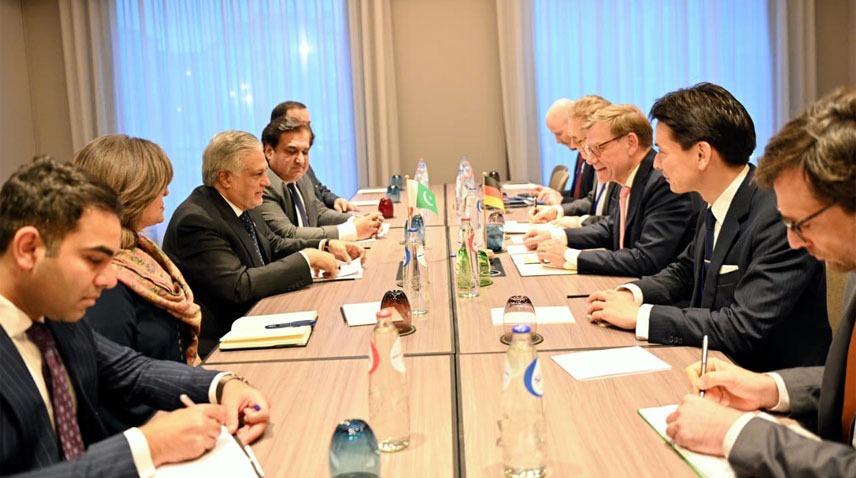
This came at a meeting between Deputy Prime Minister and Foreign Minister Ishaq Dar and German Foreign Minister Johann Wadephul on the sidelines of the fourth EU Indo-Pacific Ministerial Forum in Brussels.
The Deputy Prime Minister appreciated Germany’s commitment of 114 million euros for 2025-26, focused on climate and energy transition, sustainable economic development, vocational training, and social protection in Pakistan.
Ishaq Dar also invited the German leadership to visit Pakistan.
During the meeting, both sides expressed satisfaction with the positive trajectory of Pakistan-Germany relations.
They also exchanged views on regional and global developments and agreed to maintain close dialogue to promote mutual understanding and enhance collaboration in areas of shared interest.
Meanwhile, Ishaq Dar also met with the Secretary of Foreign Affairs of Philippines Ma. Theresa P. Lazaro on the sidelines of fourth EU Indo-Pacific Ministerial Forum in Brussels.
The two sides reviewed the entire spectrum of bilateral relations and identified opportunities and possibilities for further mutual cooperation.
Both sides expressed satisfaction at their ongoing collaboration at the UN and other multilateral fora, especially through support to each other’s candidatures and reaffirmed their commitment to stay in close contact.
Besides, the Deputy Prime Minister met with the Deputy Minister of Foreign Affairs and Foreign Employment of Sri Lanka, Arun Hemachandra on the sidelines of fourth EU Indo-Pacific Ministerial Forum in Brussels.
During the meeting, they highlighted the importance of strengthening the existing fraternal relations between the two countries through high-level exchanges.
Both ministers underlined the need to capitalize on the immense goodwill that exists between Pakistan and Sri Lanka by expanding cooperation across diverse areas, including trade and investment, tourism, culture, education, defence, agriculture and human resource development.
Both sides also agreed to continue close collaboration bilaterally and at multilateral fora.