
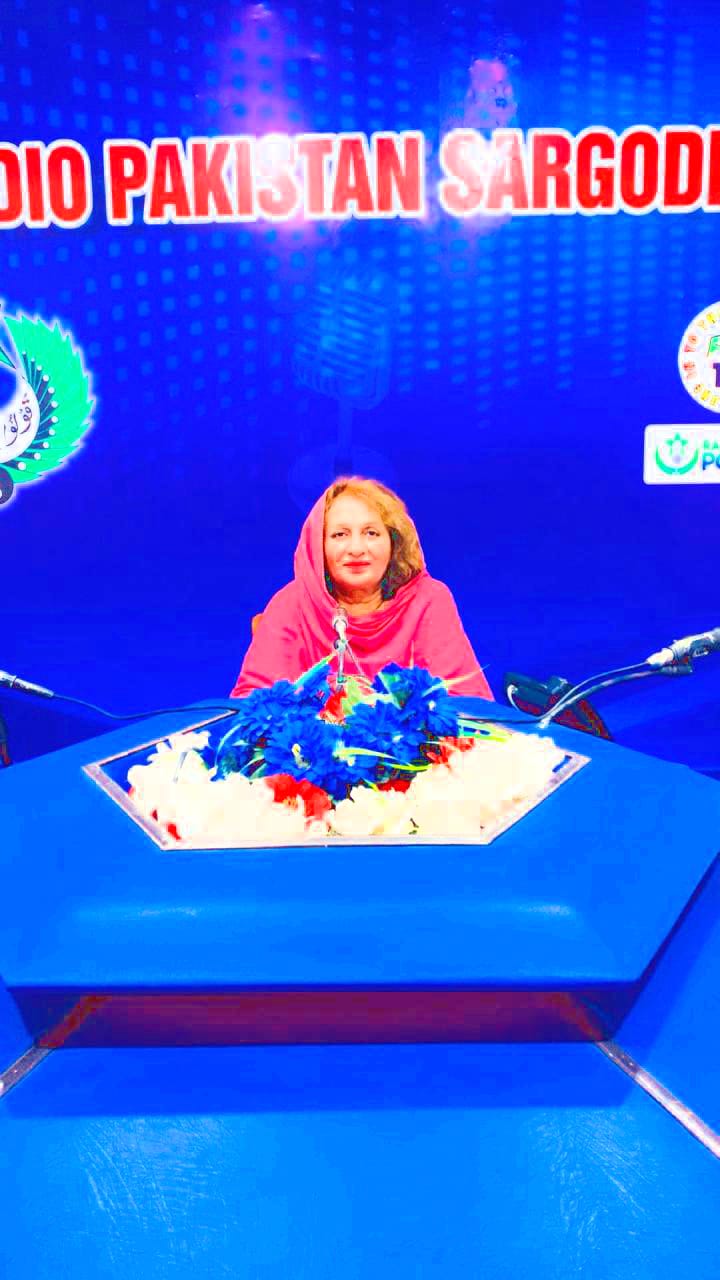
Speaking in Radio Pakistan Sargodha’s literary program Adab Nama, noted writer and researcher Munazza Anwar Goindi highlighted the impact of Marthiya writing on Urdu literature, stating that this literary genre has significantly enriched Urdu poetry and contributed to the promotion of language, culture, and social values.
She said that Marthiya has played a crucial role in preserving historical heritage while also contributing to the linguistic development of Urdu. According to her, the genre introduced countless new words, similes, and metaphors into the language. Renowned poets such as Mir Anees and Mirza Dabeer expanded the expressive capacity of Urdu and gave it greater fluency and refinement.
Munazza Goindi noted that Marthiya laid the foundation for cultural representation and character portrayal in Urdu literature. It also promoted noble human values and emotions, including sacrifice, patience, courage, justice, and support for the oppressed. She added that poets such as Mir Zamir and Mir Khaliq elevated the genre through the Musaddas form, while Josh Malihabadi used it to convey messages of revolution and freedom.
She further explained that the scope of Marthiya is remarkably broad, encompassing emotional expression, narrative description, scenic portrayal, Hamd, Naat, Manqabat, Salaam, Noha, Soz Khwani, praise, literary etiquette, and depictions of both battle and social gatherings.
Discussing literary aesthetics, she said that no literary work can be considered a masterpiece if it lacks artistic beauty. Therefore, poets who are naturally gifted with creative talent continue to shine in literary history. She emphasized that one of the defining qualities of great poetry is its ability to reveal new meanings and dimensions with every reading, a characteristic that is abundantly present in Marthiya.
Referring to the literary history of Sargodha, Munazza Goindi stated that Allama Rashk Turabi, Johar Nizami, Akhtar Sarhadi, and Muhammad Hussain Shauq are regarded as prominent names in the field of Marthiya writing. In prose literature, she described the writings of her father, Anwar Goindi, as valuable historical references. She also mentioned that his short story “Mera Gham” (My Sorrow), based on the events of Muharram, holds the status of an autobiographical narrative and occupies a distinguished place in Urdu fiction.